All eukaryotic cellular mRNAs are blocked at their 5-prime ends with the 7-methylguanosine cap structure, m7GpppX (where X is any nucleotide). This structure is involved in several cellular processes including enhanced translational efficiency, splicing, mRNA stability, and RNA nuclear export. EIF4E is a eukaryotic translation initiation factor involved in directing ribosomes to the cap structure of mRNAs. It is a 24-kD polypeptide that exists as both a free form and as part of a multiprotein complex termed EIF4F. The EIF4E polypeptide is the rate-limiting component of the eukaryotic translation apparatus and is involved in the mRNA-ribosome binding step of eukaryotic protein synthesis. The other subunits of EIF4F are a 50-kD polypeptide, termed EIF4A (see MIM 601102), that possesses ATPase and RNA helicase activities, and a 220-kD polypeptide, EIF4G (MIM 600495) (Rychlik et al., 1987 [PubMed 3469651]).[supplied by OMIM]
FUNCTION:SwissProt: P06730 # Recognizes and binds the 7-methylguanosine-containing mRNA cap during an early step in the initiation of protein synthesis and facilitates ribosome binding by inducing the unwinding of the mRNAs secondary structures. SIZE:217 amino acids; 25097 Da SUBUNIT:eIF4F is a multi-subunit complex, the composition of which varies with external and internal environmental conditions. It is composed of at least EIF4A, EIF4E and EIF4G1/EIF4G3. EIF4E is also known to interact with other partners. The interaction with EIF4ENIF1 mediates the import into the nucleus. Nonphosphorylated EIF4EBP1, EIF4EBP2 and EIF4EBP3 compete with EIF4G1/EIF4G3 to interact with EIF4E; insulin stimulated MAP- kinase (MAPK1 and MAPK3) phosphorylation of EIF4EBP1 causes dissociation of the complex allowing EIF4G1/EIF4G3 to bind and consequent initiation of translation. Rapamycin can attenuate insulin stimulation, mediated by FKBPs. Interacts mutually exclusive with EIF4A1 and EIF4A2. Interacts with NGDN (By similarity). Interacts with Lassa virus Z protein. PTM:Phosphorylation increases the ability of the protein to bind to mRNA caps and to form the eIF4F complex. SIMILARITY:SwissProt: P06730 ## Belongs to the eukaryotic initiation factor 4E family.
Product Usage Statements
Quality Assurance
Routinely evaluated by immunoblot.
Usage Statement
Unless otherwise stated in our catalog or other company documentation accompanying the product(s), our products are intended for research use only and are not to be used for any other purpose, which includes but is not limited to, unauthorized commercial uses, in vitro diagnostic uses, ex vivo or in vivo therapeutic uses or any type of consumption or application to humans or animals.
Storage and Shipping Information
Storage Conditions
2 years at -20°C from date of shipment.
Upon first thaw, and prior to removing the cap, centrifuge the vial and gently mix the solution. Aliquot into microcentrifuge tubes and store at -20°C.Avoid repeated freeze/thaw cycles, which may damage IgG and affect product performance.Note: Variability in freezer temperatures below -20°C may cause glycerol-containing solutions to become frozen during storage.
Packaging Information
Material Size
100 µL
原厂资料:
Key Spec Table
Species Reactivity
Key Applications
Host
Format
Antibody Type
R, H, M
IH(P), FC, IP, WB
Rb
Purified
Monoclonal Antibody
Description
Catalogue Number
04-347
Brand Family
Upstate
Trade Name
Upstate
Description
Anti-eIF-4E CT Antibody, rabbit monoclonal
Alternate Names
eIF-4e
D-eIF4E
Eif4e
IF4E
deIF4E
eIF-4E1
eIF-4E2
eIF-4EII
Product Information
Format
Purified
Presentation
100 μL of rabbit monoclonal IgG in 30 mM Tris-Glycine (pH 7.4), 90 mM NaCl, 0.006% sodium azide, 0.03% BSA and 40% glycerol.
Applications
Application
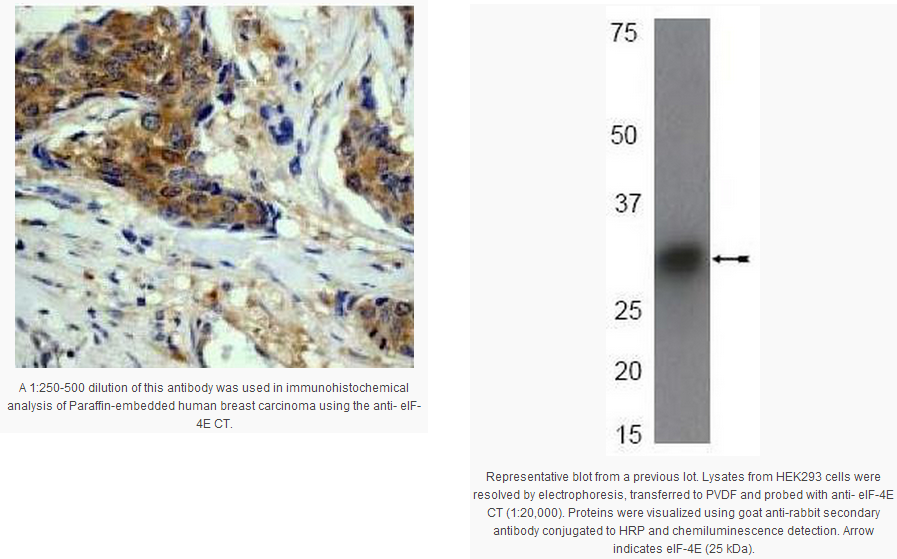
Detect eIF-4E CT using this Anti-eIF-4E CT Antibody, Rabbit validated for use in FC, IP, WB, IH(P).
All eukaryotic cellular mRNAs are blocked at their 5-prime ends with the 7-methylguanosine cap structure, m7GpppX (where X is any nucleotide). This structure is involved in several cellular processes including enhanced translational efficiency, splicing, mRNA stability, and RNA nuclear export. EIF4E is a eukaryotic translation initiation factor involved in directing ribosomes to the cap structure of mRNAs. It is a 24-kD polypeptide that exists as both a free form and as part of a multiprotein complex termed EIF4F. The EIF4E polypeptide is the rate-limiting component of the eukaryotic translation apparatus and is involved in the mRNA-ribosome binding step of eukaryotic protein synthesis. The other subunits of EIF4F are a 50-kD polypeptide, termed EIF4A (see MIM 601102), that possesses ATPase and RNA helicase activities, and a 220-kD polypeptide, EIF4G (MIM 600495) (Rychlik et al., 1987 [PubMed 3469651]).[supplied by OMIM]
FUNCTION:SwissProt: P06730 # Recognizes and binds the 7-methylguanosine-containing mRNA cap during an early step in the initiation of protein synthesis and facilitates ribosome binding by inducing the unwinding of the mRNAs secondary structures. SIZE:217 amino acids; 25097 Da SUBUNIT:eIF4F is a multi-subunit complex, the composition of which varies with external and internal environmental conditions. It is composed of at least EIF4A, EIF4E and EIF4G1/EIF4G3. EIF4E is also known to interact with other partners. The interaction with EIF4ENIF1 mediates the import into the nucleus. Nonphosphorylated EIF4EBP1, EIF4EBP2 and EIF4EBP3 compete with EIF4G1/EIF4G3 to interact with EIF4E; insulin stimulated MAP- kinase (MAPK1 and MAPK3) phosphorylation of EIF4EBP1 causes dissociation of the complex allowing EIF4G1/EIF4G3 to bind and consequent initiation of translation. Rapamycin can attenuate insulin stimulation, mediated by FKBPs. Interacts mutually exclusive with EIF4A1 and EIF4A2. Interacts with NGDN (By similarity). Interacts with Lassa virus Z protein. PTM:Phosphorylation increases the ability of the protein to bind to mRNA caps and to form the eIF4F complex. SIMILARITY:SwissProt: P06730 ## Belongs to the eukaryotic initiation factor 4E family.
Product Usage Statements
Quality Assurance
Routinely evaluated by immunoblot.
Usage Statement
Unless otherwise stated in our catalog or other company documentation accompanying the product(s), our products are intended for research use only and are not to be used for any other purpose, which includes but is not limited to, unauthorized commercial uses, in vitro diagnostic uses, ex vivo or in vivo therapeutic uses or any type of consumption or application to humans or animals.
Storage and Shipping Information
Storage Conditions
2 years at -20°C from date of shipment.
Upon first thaw, and prior to removing the cap, centrifuge the vial and gently mix the solution. Aliquot into microcentrifuge tubes and store at -20°C.Avoid repeated freeze/thaw cycles, which may damage IgG and affect product performance.Note: Variability in freezer temperatures below -20°C may cause glycerol-containing solutions to become frozen during storage.








 京公网安备11010802025653 版权所有:北京逸优科技有限公司