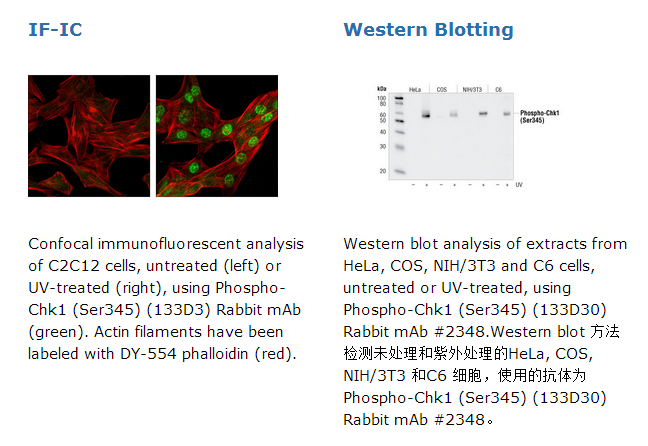




Each phospho-specific Chk1 antibody detects endogenous levels of Chk1 when phosphorylated at the indicated site (Ser296, Ser317 or Ser345), and each phospho-specific Chk2 antibody detects endogenous levels Chk2 only when phosphorylated at the indicated site (Ser19, Ser33/35, Thr68, and Ser516). Chk1 Antibody #2345 detects endogenous levels of total Chk1. Chk2 Antibody #2662 detects endogenous levels of total Chk2.
Source / Purification
Monoclonal antibody is produced by immunizing animals with a synthetic phosphopeptide corresponding to residues surrounding Ser345 of human Chk1. Polyclonal antibodies are produced by immunizing animals with synthetic phosphopeptides corresponding to residues surrounding Ser296 or Ser317 of human Chk1 and Ser19, Ser33/35, Thr68, Ser516 of human Chk2. Chk1 Antibody #2345 is produced by immunizing rabbits with a synthetic peptide corresponding to residues around Ser296 of human Chk1. Chk 2 Antibody #2662 is produced by immunizing rabbits with a synthetic peptide corresponding to amino-terminal residues of human Chk2. Polyclonal antibodies are purified by protein A and peptide affinity chromatography.
Description
The Phospho-Chk1/2 Antibody Sampler Kit offers an economical means to evaluate the phosphorylation status of Chk1 and Chk2 on multiple residues. The kit contains enough primary and secondary antibodies to perform four Western blot experiments with each primary antibody.
Background
Chk1 kinase acts downstream of ATM/ATR kinase and plays an important role in DNA damage checkpoint control, embryonic development, and tumor suppression (1). Activation of Chk1 involves phosphorylation at Ser317 and Ser345 and occurs in response to blocked DNA replication and certain forms of genotoxic stress (2). While phosphorylation at Ser345 serves to localize Chk1 to the nucleus following checkpoint activation (3), phosphorylation at Ser317 along with site-specific phosphorylation of PTEN allows for reentry into the cell cycle following stalled DNA replication (4). Chk1 exerts its checkpoint mechanism on the cell cycle, in part, by regulating the cdc25 family of phosphatases. Chk1 phosphorylation of cdc25A targets it for proteolysis and inhibits its activity through 14-3-3 binding (5). Activated Chk1 can inactivate cdc25C via phosphorylation at Ser216, blocking the activation of cdc2 and transition into mitosis (6). Centrosomal Chk1 has been shown to phosphorylate cdc25B and inhibit its activation of CDK1-cyclin B1, thereby abrogating mitotic spindle formation and chromatin condensation (7). Furthermore, Chk1 plays a role in spindle checkpoint function through regulation of Aurora B and BubR1 (8). Chk1 has emerged as a drug target for cancer therapy as its inhibition leads to cell death in many cancer cell lines (9).Chk2 is the mammalian homologue of the budding yeast Rad53 and fission yeast Cds1 checkpoint kinases (5-7). The amino-terminal domain of Chk2 contains a series of seven serine or threonine residues (Ser19, Thr26, Ser28, Ser33, Ser35, Ser50 and Thr68) followed by glutamine (SQ or TQ motif). These are known to be preferred sites for phosphorylation by ATM/ATR kinases (8). Indeed, after DNA damage by ionizing radiation (IR), UV irradiation and DNA replication blocked by hydroxyurea, Thr68 and other sites in this region become phosphorylated by ATM/ATR (9-11). The SQ/TQ cluster domain, therefore, seems to have a regulatory function. Phosphorylation at Thr68 is a prerequisite for the subsequent activation step, which is attributable to autophosphorylation of Chk2 on residues Thr383 and Thr387 in the activation loop of the kinase domain (12).