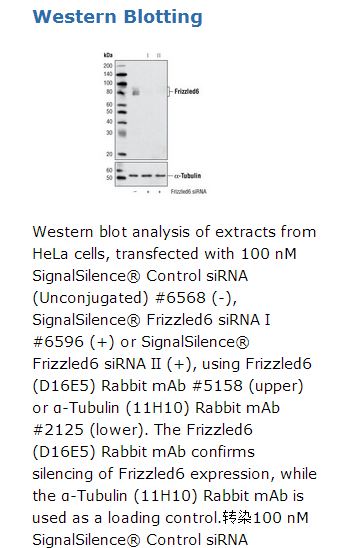
SignalSilence® Frizzled6 siRNA II from Cell Signaling Technology (CST) allows the researcher to specifically inhibit Frizzled6 expression using RNA interference, a method whereby gene expression can be selectively silenced through the delivery of double stranded RNA molecules into the cell. All SignalSilence® siRNA products from CST are rigorously tested in-house and have been shown to reduce target protein expression by western analysis.
Quality Control
Oligonucleotide synthesis is monitored base by base through trityl analysis to ensure appropriate coupling efficiency. The oligo is subsequently purified by affinity-solid phase extraction. The annealed RNA duplex is further analyzed by mass spectrometry to verify the exact composition of the duplex. Each lot is compared to the previous lot by mass spectrometry to ensure maximum lot-to-lot consistency.
Directions for Use
CST recommends transfection with 100 nM Frizzled6 siRNA II 48 to 72 hours prior to cell lysis. For transfection procedure, follow protocol provided by the transfection reagent manufacturer. Please feel free to contact CST with any questions on use.。
Background
Frizzled (Fzd) belongs to the seven transmembrane-spanning G-protein-coupled receptor (GPCR) superfamily (1). Fzds have a large extracellular N-terminal region containing a cysteine-rich domain (CRD), which is involved in binding to Wnt proteins (1,2). The intracellular C-terminus binds to the PDZ domain of Dvl proteins, a major signaling component downstream of Fzd (3). Wnt proteins bind to Fzd and the co-receptors LRP5 or LPR6, and activate Wnt/β-catenin pathway through inhibiting phosphorylation of β-catenin by GSK3-β (4,5). In addition to this canonical Wnt/β-catenin pathway, some Wnt proteins can also activate the Fzd/Ca2+ pathway and Fzd/PCP (planar cell polarity) pathway (6,7). The mammalian Fzd subfamily has 10 members (Fzd1 to Fzd10) and they may mediate signaling through different pathways (8). Some Fzds can also bind to other secreted proteins, like Norrin and R-Spondin (9-11).








 京公网安备11010802025653 版权所有:北京逸优科技有限公司