Species predicted to react based on 100% sequence homology:Bovine
Specificity / Sensitivity
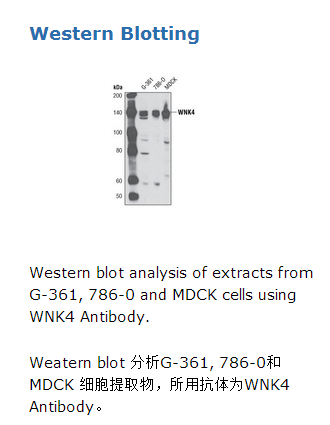
WNK4 Antibody detects endogenous levels of total WNK4 protein.
Source / Purification
Polyclonal antibodies are produced by immunizing animals with a sythetic peptide corresponding to residues surrounding Lys59 of human WNK4. Antibodies were purified by protein A and peptide affinity chromatography.
Background
The WNK [with no lysine (K)] family of serine/threonine kinases is characterized by having a cysteine in place of lysine in subdomain II of its kinase activation domain (1,2). The lysine necessary for phosphoryl transfer is located in an atypical position in the catalytic domain. Four WNK family members have been identified in humans (WNK1-4) and have been implicated in regulating ion permeability (3). Mutations in the WNK1 and WNK4 genes in humans cause pseudohypoaldosteronism type II (PHAII), an autosomal dominant disorder leading to hypertension, hyperkalemia, and renal tubular acidosis (4). WNK4 is specifically expressed in the kidney, whereas WNK1 has a wider distribution but is predominantly expressed in polarized epithelia (1-3). Heterozygous mutations in WNK1 in mice result in a significant decrease in blood pressure, while homozygous mutations are embryonic lethal (5). WNK1 is phosphorylated by Akt at Thr60 (6). In addition, WNK1 may be autophosphorylated at Ser382 in the activation loop, and this is thought to be required for its kinase activity (7).








 京公网安备11010802025653 版权所有:北京逸优科技有限公司