Species predicted to react based on 100% sequence homology:Rat
Specificity / Sensitivity
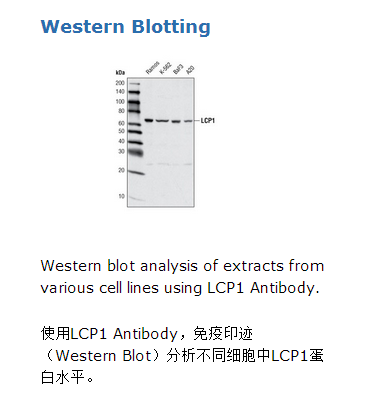
LCP1 Antibody detects endogenous levels of total LCP1 protein.
Source / Purification
Polyclonal antibodies are produced by immunizing animals with a synthetic peptide corresponding to residues surrounding Asp292 of human LCP1 protein. Antibodies are purified by protein A and peptide affinity chromatography.
Background
Highly conserved and widely expressed plastin proteins comprise a subset of actin-binding proteins that include proteins that promote actin bundling. Three plastins exhibiting differential expression are found in mammals and include L-plastin, T-plastin and I-plastin. T-plastin (plastin-3) is found in cells of most solid tissues while I-plastin (plastin-1) is expressed specifically in kidney, colon and small intestine (1-3). L-plastin (plastin-2) or LCP1 (lymphocyte cytosolic protein 1) is mainly expressed in hematopoietic cells and nonhematopoietic tumors, including increased expression correlated with metastatic progression in colon cancer cell lines (4). Overexpression of LCP1 in premetastatic cancer cell lines induces invasion and loss of E-cadherin expression, which is characteristic of metastatic cancer cell lines (5). LCP1 becomes phosphorylated at Ser5 upon stimulation through the T-cell receptor/co-receptor complex (TCR/CD3) in association with the CD2 cell adhesion molecule or the CD28 receptor (6). Phosphorylation at Ser5 increases LCP1 ability to bind F-actin and increase cell motility (7,8).








 京公网安备11010802025653 版权所有:北京逸优科技有限公司