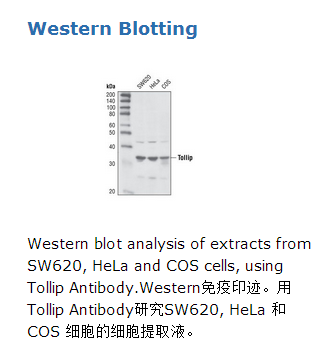
Tollip Antibody detects endogenous levels of total Tollip protein.
Source / Purification
Polyclonal antibodies are produced by immunizing animals with a synthetic peptide corresponding to residues surrounding cysteine 229 of human Tollip. Antibodies are purified by protein A and peptide affinity chromatography.
Background
Members of the Toll-like receptor (TLR) family, named for the closely related Toll receptor in Drosophila, play a pivotal role in innate immune responses (1-3). TLRs recognize conserved motifs found in various pathogens and mediate defense responses. Triggering of the TLR pathway leads to the activation of NF-κB and subsequent regulation of immune and inflammatory genes. The TLRs and members of the IL-1 receptor family share a conserved stretch of approximately 200 amino acids known as the TIR domain. Upon activation, TLRs associate with a number of cytoplasmic adaptor proteins containing TIR domains including MyD88 (myeloid differentiation factor), MAL/TIRAP (MyD88-adaptor-like/TIR-associated protein), TRIF (Toll-receptor-associated activator of interferon), and TRAM (Toll-receptor-associated molecule). This association leads to the recruitment and activation of IRAK1 and IRAK4, which form a complex with TRAF6 to activate TAK1 and IKK. Activation of IKK leads to the degradation of IκB that normally maintains NF-κB inactivity by sequestering it in the cytoplasm.Tollip (Toll interacting protein) is an adaptor protein discovered to be associated with the IRAK complex and recruited to IL1-R following IL-1 stimulation (4). Overexpression of Tollip results in impaired NF-κB signaling (4). Tollip also associates directly with TLR2 and TLR4 and inhibits TLR-mediated signaling through inhibition of IRAK (5). Studies of Tollip deficient mice suggest that it plays a role in the regulation of inflammatory cytokines in response to IL-1 and LPS (6).








 京公网安备11010802025653 版权所有:北京逸优科技有限公司