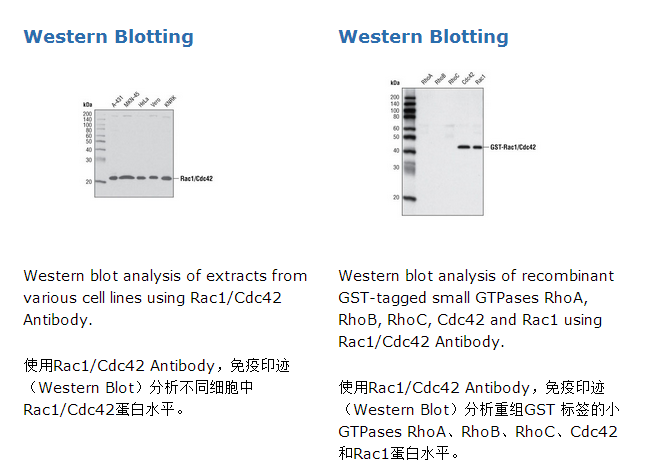
Rac1/Cdc42 Antibody recognizes endogenous levels of total rac1 and cdc42 protein. Based on sequence similarities, the antibody may react with rac2 and rac3. The antibody does not cross-react with rhoA, rhoB or rhoC.
Source / Purification
Polyclonal antibodies are produced by immunizing animals with a synthetic peptide corresponding to residues near the amino termini of human rac1 and cdc42. Antibodies are purified using protein A and peptide affinity chromatography.
Background
Rac and Cdc42 are members of the Rho-GTPase family. In mammals, Rac exists as three isoforms, Rac1, Rac2 and Rac3, which are highly similar in sequence. Rac1 and Cdc42, the most widely studied of this group, are ubiquitously expressed. Rac2 is expressed in cells of hematopoietic origin, and Rac3, while highly expressed in brain, is also found in many other tissues. Rac and Cdc42 play key signaling roles in cytoskeletal reorganization, membrane trafficking, transcriptional regulation, cell growth and development (1). GTP binding stimulates the activity of Rac/Cdc42, and the hydrolysis of GTP to GDP through the protein's intrinsic GTPase activity, rendering it inactive. GTP hydrolysis is aided by GTPase activating proteins (GAPs), while exchange of GDP for GTP is facilitated by guanine nucleotide exchange factors (GEFs). Another level of regulation is achieved through the binding of RhoGDI, a guanine nucleotide dissociation inhibitor, which retains Rho family GTPases, including Rac and Cdc42, in their inactive GDP-bound state (2,3).








 京公网安备11010802025653 版权所有:北京逸优科技有限公司