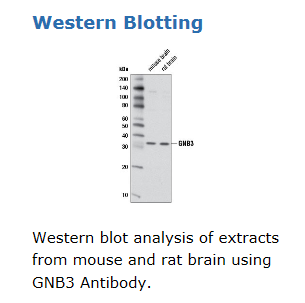
GNB3 Antibody recognizes endogenous levels of total GNB3 protein.
Source / Purification
Polyclonal antibodies are produced by immunizing animals with a synthetic peptide corresponding to residues surrounding Ile123 of human GNB3 protein. Antibodies are purified by protein A and peptide affinity chromatography.
原厂资料:
Specificity / Sensitivity
GNB3 Antibody recognizes endogenous levels of total GNB3 protein.
Source / Purification
Polyclonal antibodies are produced by immunizing animals with a synthetic peptide corresponding to residues surrounding Ile123 of human GNB3 protein. Antibodies are purified by protein A and peptide affinity chromatography.
Background
Heterotrimeric guanine nucleotide-binding proteins, G proteins, transduce ligand binding to G protein-coupled receptors (GPCRs) into intracellular responses (1). G proteins are comprised of 3 subunits, alpha (Gα), beta (Gβ), and gamma (Gγ). Upon activation of GPCRs, the receptor promotes the exchange of GDP to GTP of Gα, changing the confirmation of the switch regions within Gα. The receptor bound heterotimeric G protein (inactive) is then released, and dissociates into the GTP-bound Gα (active) monomer and the Gβ/Gγ heterodimer (1,2). Gα activates adenylyl cyclase, which converts ATP to the second messenger cAMP. Gα also activates phosphoinositide-specific phospholipase C (PLC), which catalyzes hydrolysis of the phospholipid of phosphatidylinositol 4,5-biphosphate (PIP2), releasing the second messengers IP3 and 1,2-diacylglycerol (DAG). IP3 activates IP3 receptors to release Ca2+ from the ER. DAG is an activator of protein kinase C (PKC), which in turn activates the Erk1/2 pathway (1,3). The primary function of the Gβ/Gγ heterodimer is to inhibit Gα, although it may also activate second messengers (e.g. PLC pathway) or gate ion channels (e.g. GIRK) (1). Guanine nucleotide-binding protein b3 (GNB3) is an isoform of the b subunit. Research studies have shown that a polymorphism in the GNB3 gene, C825T, is associated with hypertension, obesity, and depression (4).








 京公网安备11010802025653 版权所有:北京逸优科技有限公司