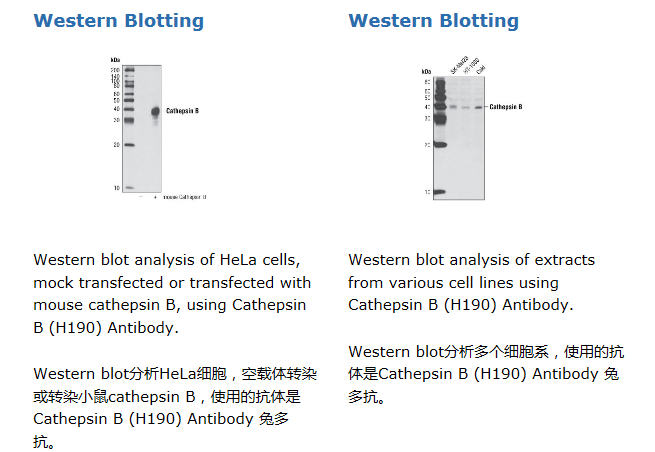
Cathepsin B (H190) Antibody (Mouse Preferred) detects endogenous levels of total cathepsin B protein. Cathepsin B (G60) Antibody #3373 produces a stronger signal for human cathepsin B on western blot, while Cathepsin B (H190) Antibody is preferred for the mouse protein.
Source / Purification
Polyclonal antibodies are produced by immunizing animals with a synthetic peptide corresponding to residues surrounding His190 of human cathepsin B in a region that is conserved in mouse and rat. Antibodies are purified by protein A and peptide affinity chromatography.
Background
Cathepsin B (CSTB), part of the papain family of proteases, is a widely expressed lysosomal cysteine endopeptidase (1,2). Like other family members, cathepsin B is produced from a larger precursor form, pro-cathepsin B, which in its glycosylated form runs at approximately 40 kDa on SDS-PAGE, and is then activated by cleavage of a 62-amino acid pro-peptide. High levels of cathepsin B are found in macrophages and osteoclasts, as well as various types of cancer cells, including lung, colon, prostate, breast, and stomach. In addition, expression of cathepsin B has been associated with multiple sclerosis (3), rheumatoid arthritis (4), and pancreatitis (5). While generally localized to lysosomes, in cancer alterations can lead to its secretion (6). Its role in tumor progression is thought to involve promotion of basement membrane degradation, invasion and metastasis (7,8). Expression can correlate with poor prognosis for a variety of forms of cancer (9-13).








 京公网安备11010802025653 版权所有:北京逸优科技有限公司