Species predicted to react based on 100% sequence homology:Xenopus
Specificity / Sensitivity
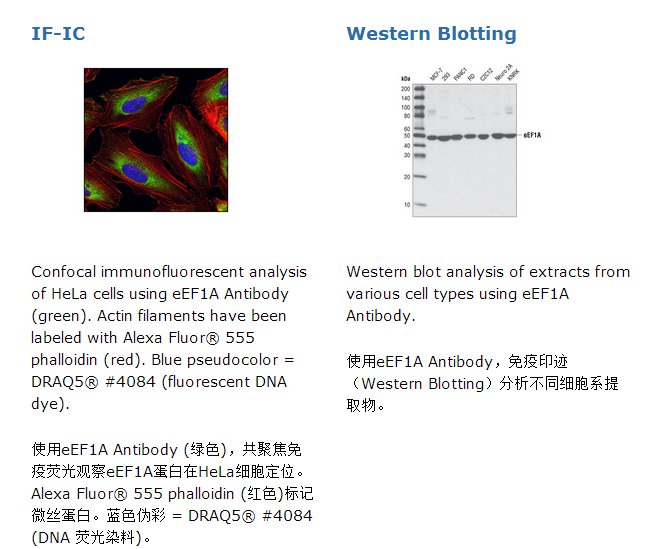
eEF1A Antibody detects endogenous levels of total eEF1A protein.
Source / Purification
Polyclonal antibodies are produced by immunizing animals with a synthetic peptide corresponding to a sequence at the C-terminal end of human eEF1A. Antibodies are purified by peptide affinity chromatography.
Background
Translation is the process where amino acid residues are assembled into polypeptides on ribosomes. This process is generally divided into three stages: initiation, elongation and termination. During elongation, mRNA and tRNA pair at the two active sites (A and P sites) on the ribosome. A number of eukaryotic elongation factors (eEFs) are involved in this process in mammalian cells (1). eEF1A, also called elongation factor Tu (EF-Tu), binds GTP and interacts with amino acyl-tRNAs to promote recruitment of amino acyl-tRNAs to the A-site of the ribosome (1). After GTP hydrolysis, GDP-eEF1A leaves the ribosome and is later converted back to the GTP-eEF1A by eEF1B (1). Studies have shown that eEF1A is phosphorylated under certain conditions, indicating that its activity is regulated at the post-translational level (2,3).








 京公网安备11010802025653 版权所有:北京逸优科技有限公司