Species predicted to react based on 100% sequence homology:Monkey
Specificity / Sensitivity
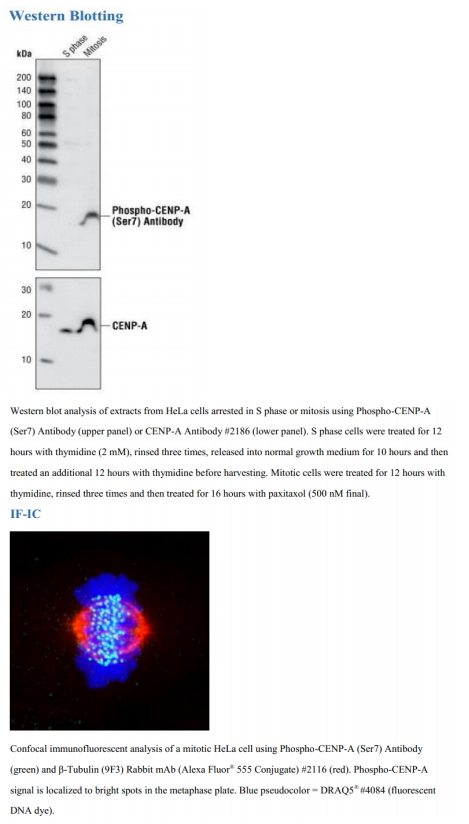
Phospho-CENP-A (Ser7) Antibody detects endogenous levels of human CENP-A protein only when phosphorylated on Ser7. This antibody does not cross-react with other histone proteins, including Histone H3.
Source / Purification
Polyclonal antibodies are produced by immunizing animals with a synthetic phosphopeptide corresponding to residues surrounding Ser7 of human CENP-A protein. Antibodies are purified by peptide affinity chromatography.
Background
Modulation of chromatin structure plays a critical role in the regulation of transcription and replication of the eukaryotic genome. The nucleosome, made up of four core histone proteins (H2A, H2B, H3, and H4), is the primary building block of chromatin. In addition to the growing number of post-translational histone modifications regulating chromatin structure, cells can also exchange canonical histones with variant histones that can directly or indirectly modulate chromatin structure (1). CENP-A, also known as the chromatin-associated protein CSE4 (capping-enzyme suppressor 4-p), is an essential histone H3 variant that replaces canonical histone H3 in centromeric heterochromatin (2). The greatest divergence between CENP-A and canonical histone H3 occurs in the amino-terminal tail of the protein, which binds linker DNA between nucleosomes and facilitates proper folding of centromeric heterochromatin (3). The amino-terminal tail of CENP-A is also required for recruitment of other centromeric proteins (CENP-C, hSMC1, hZW10), proper kinetochore assembly and chromosome segregation during mitosis (4). Additional sequence divergence in the histone fold domain is responsible for correct targeting of CENP-A to the centromere (5). Many of the functions of CENP-A are regulated by phosphorylation (6,7). Aurora A-dependent phosphorylation of CENP-A on Ser7 during prophase is required for proper targeting of Aurora B to the inner centromere in prometaphase, proper kinetochore/microtubule attachment and proper alignment of chromosomes during mitosis (6).
注意事项:
Storage: Supplied in 10 mM sodium HEPES (pH 7.5), 150 mM
NaCl, 100 µg/ml BSA and 50% glycerol. Store at –20°C.
Do not aliquot the antibody.








 京公网安备11010802025653 版权所有:北京逸优科技有限公司