Species predicted to react based on 100% sequence homology:Pig
Specificity / Sensitivity
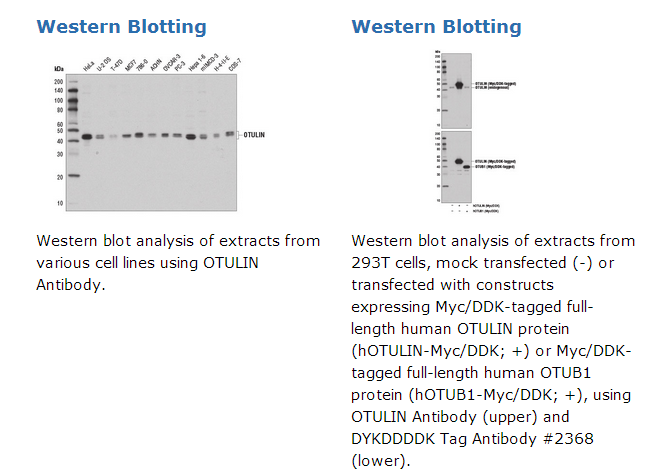
OTULIN Antibody recognizes endogenous levels of total OTULIN protein. This antibody does not cross-react with OTUB1.
Source / Purification
Polyclonal antibodies are produced by immunizing animals with a synthetic peptide corresponding to residues near the amino terminus of human OTULIN protein. Antibodies are purified by protein A and peptide affinity chromatography.
原厂资料:
Homology
Species predicted to react based on 100% sequence homology:Pig
Specificity / Sensitivity
OTULIN Antibody recognizes endogenous levels of total OTULIN protein. This antibody does not cross-react with OTUB1.
Source / Purification
Polyclonal antibodies are produced by immunizing animals with a synthetic peptide corresponding to residues near the amino terminus of human OTULIN protein. Antibodies are purified by protein A and peptide affinity chromatography.
Background
Protein ubiquitination and deubiquitination are reversible processes catalyzed by ubiquitinating enzymes (UBEs) and deubiquitinating enzymes (DUBs) (1,2). Five subfamilies of DUBs have been characterized to date, and include USP, UCH, OTU, MJD, and JAMM deubiquitinating enzymes (1,2). The ovarian tumor (OTU) DUB subfamily comprises a group of approximately 100 putative cysteine proteases that are homologous to theDrosophilaovarian tumor gene product (3). OTU domain-containing deubiquitinase with linear linkage specificity (OTULIN, FAM105B, Gumby) is an OTU subfamily deubiquitinating enzyme that antagonizes the E3 linear ubiquitin chain assembly complex (LUBAC) by promoting disassembly of Met1-linked (linear) ubiquitin chains (4,5). LUBAC and OTULIN regulate NOD2 signaling in an antagonistic manner by controlling the level of Met1-ubiquitinated RIPK2 kinase (6). Binding of the OTULIN PUB-interacting motif to the HOIP subunit of LUBAC is critical for OTULIN inhibition of NF-κΒ signaling; this OTULIN-HOIP interaction is negatively regulated by tyrosine phosphorylation of OTULIN (7,8). The ability of OTULIN to influence LUBAC function and the presence of linear ubiquitin chains may play an important role in regulating angiogenesis, craniofacial, and neural development (5).








 京公网安备11010802025653 版权所有:北京逸优科技有限公司