其它组分:
USP14 (D8Q6S) Rabbit mAb 【子货号:#11931,包装:40 µl,,运保温度: –20°C.】
USP28 Antibody 【子货号:#4217,包装:40 µl,,运保温度: –20°C.】
USP18 (D4E7) Rabbit mAb 【子货号:#4813,包装:40 µl,,运保温度: –20°C.】
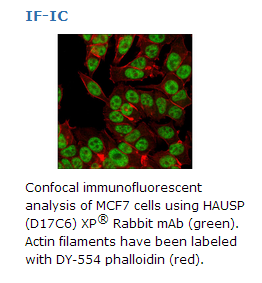
HAUSP (D17C6) XP® Rabbit mAb 【子货号:#4833,包装:40 µl,,运保温度: –20°C.】
USP9X Antibody 【子货号:#5751,包装:40 µl,,运保温度: –20°C.】
Anti-rabbit IgG, HRP-linked Antibody 【子货号:#7074,包装:100 µl,,运保温度: –20°C.】
USP1 (D37B4) Rabbit mAb 【子货号:#8033,包装:40 µl,,运保温度: –20°C.】
USP2 Antibody 【子货号:#8036,包装:40 µl,,运保温度: –20°C.】
USP10 (D7A5) Rabbit mAb 【子货号:#8501,包装:40 µl,,运保温度: –20°C.】
USP8 Antibody 【子货号:#8728,包装:40 µl,,运保温度: –20°C.】
描述:
Specificity / Sensitivity
Each antibody in the USP Antibody Sampler Kit recognizes endogenous levels of its respective target protein, except for USP28, which detects transfected levels of its target protein. USP2 Antibody cross-reacts with all known USP2 splice variants but does not cross-react with USP21. USP9X Antibody may also cross-react with USP9Y. Based on sequence alignment, USP14 Antibody is predicted to cross-react with both isoform a and isoform b of USP14. The doublet band detected by western blot for USP18 (D4E7) Rabbit mAb represents full-length (39 kDa) and amino-terminal deleted derivative of USP18 (31).
Source / Purification
Monoclonal antibodies are produced by immunizing animals with a synthetic peptide corresponding to the carboxy terminus of human HAUSP protein, residues surrounding Leu768 of human USP1 protein, the amino terminus of human USP10 protein, or residues surrounding Pro45 of human USP18 protein. Polyclonal antibodies are produced by immunizing animals with a synthetic peptide corresponding to residues surrounding Leu387 of human USP2 protein, Pro320 of human USP8 protein, Phe2137 of human USP9X protein, residues near the carboxy terminus of human USP14 protein, or residues surrounding Ala11 of human USP28. Polyclonal antibodies are purified by protein A and peptide affinity chromatography.
Description
The USP Antibody Sampler Kit provides an economical means of detecting members of the ubiquitin-specific protease (USP) family. The kit includes enough primary antibody to perform four western blot experiments per primary antibody.
原厂资料:
Specificity / Sensitivity
Each antibody in the USP Antibody Sampler Kit recognizes endogenous levels of its respective target protein, except for USP28, which detects transfected levels of its target protein. USP2 Antibody cross-reacts with all known USP2 splice variants but does not cross-react with USP21. USP9X Antibody may also cross-react with USP9Y. Based on sequence alignment, USP14 Antibody is predicted to cross-react with both isoform a and isoform b of USP14. The doublet band detected by western blot for USP18 (D4E7) Rabbit mAb represents full-length (39 kDa) and amino-terminal deleted derivative of USP18 (31).
Source / Purification
Monoclonal antibodies are produced by immunizing animals with a synthetic peptide corresponding to the carboxy terminus of human HAUSP protein, residues surrounding Leu768 of human USP1 protein, the amino terminus of human USP10 protein, or residues surrounding Pro45 of human USP18 protein. Polyclonal antibodies are produced by immunizing animals with a synthetic peptide corresponding to residues surrounding Leu387 of human USP2 protein, Pro320 of human USP8 protein, Phe2137 of human USP9X protein, residues near the carboxy terminus of human USP14 protein, or residues surrounding Ala11 of human USP28. Polyclonal antibodies are purified by protein A and peptide affinity chromatography.
Description
The USP Antibody Sampler Kit provides an economical means of detecting members of the ubiquitin-specific protease (USP) family. The kit includes enough primary antibody to perform four western blot experiments per primary antibody.
Background
Ubiquitinating enzymes (UBEs) catalyze protein ubiquitination, a reversible process countered by deubiquitinating enzyme (DUB) action (1,2). The ubiquitin-specific protease (USP) subfamily is one of five distinct groups of DUB enzymes. Ubiquitin-specific-processing protease 1 (USP1) is regulated in a cell cycle dependent manner by both transcriptional and ubiquitin-proteasomal mechanisms (3). Nuclear USP1 localizes to chromatin where it deubiquitinates monoubiquitinated FANCD2 and plays an important role in DNA damage repair and Chk1 protein stability (3,4). Ubiquitin-specific-processing protease 2 (USP2) contains C19 peptidase activity and is involved in ubiquitin recycling and disassembly of polymeric ubiquitin and ubiquitin-like protein complexes (5). USP2 is a putative oncoprotein that is highly over expressed in prostate cancer and drives tumor growth by binding and stabilizing fatty acid synthase through deubiquitination (6,7).
Herpesvirus-associated ubiquitin-specific protease (HAUSP, USP7) binds and deubiquitinates transcription factor p53 and regulator protein Mdm2, stabilizing both proteins (8,9). HAUSP modifies other ubiquitinated proteins, including FoxO family forkhead transcription factors and the mitotic stress checkpoint protein CHFR (10,11). Ubiquitin-specific protease 8 (USP8, UBPy) is a cysteine protease and growth-regulated enzyme that is essential for cell proliferation and survival (12,13). The catalytic domain of USP9X possesses cysteine peptidase activity that cleaves ubiquitin and polyubiquitin conjugates. USP9X may help stabilize adherens and tight junction molecules during epithelial cell polarization (14,15). USP10 is regulated at the posttranslational level through protein-protein interactions and phosphorylation. Interaction of USP10 with the Ras-GAP SH3 domain binding protein (G3BP) inhibits the ability of USP10 to catalyze ubiquitin chain disassembly (16). ATM-mediated phosphorylation of USP10 at Thr42 and Ser337 promotes USP10 stabilization and relocation from the cytoplasm to the nucleus, where it functions in p53 deubiquitination, stabilization, and activation in response to genotoxic stress (17).
USP14 is recruited to the proteasome through association with the PSMD2 (S2/hRPN1) subunit of the 19S regulatory particle, where it may antagonize substrate degradation (18,19). USP14 trims ubiquitin residues from distal polyubiquitin chain ends, decreasing chain affinity for proteasome ubiquitin receptors and allowing for enhanced substrate stability (20,21). USP18 (UBP43) catalyzes the removal of the interferon-regulated, ubiquitin-like protein ISG15 from conjugated proteins (22). Removal of ISG15 from target proteins maintains a critical balance of cellular ISG15-conjugated proteins, which is important for normal development and brain function (23,24). USP28 can bind, deubiquitinate and stabilize several DNA-damage pathway proteins, including p53BP1 and Chk2 (25). USP28 plays an important role in Myc-related signaling as it catalyzes Myc deubiquitination and promotes Myc stabilization, which contributes to tumor-cell growth (26).








 京公网安备11010802025653 版权所有:北京逸优科技有限公司