Microtubule-associated proteins (MAPs) play a crucial role in the development and structure of nerve cells. These proteins are important for
the assembly and stability of microtubles during neurite outgrowth and for the morphology of neuronal processes, such as dendrites. MAP1B
encodes for a single precursor protein that is cleaved to produce a single heavy chain of 280 kDa and a light chain of 32 kDa which become
noncovalently associated. Expression levels of MAP1B are reportedly highest in the brain and are modulated during development as reported
with gene silencing experiments that implicate MAP1B's role during neuronal differentiation. In addition, MAP1B can be selectively
phosphorylated depending on the cell type, subcellular localization and developmental phase. In neurons, MAP1B is expressed as a
glycoprotein at the plasma membrane, where it can interact with proteins participating in axonal guiding. MAP1B has been reported to be
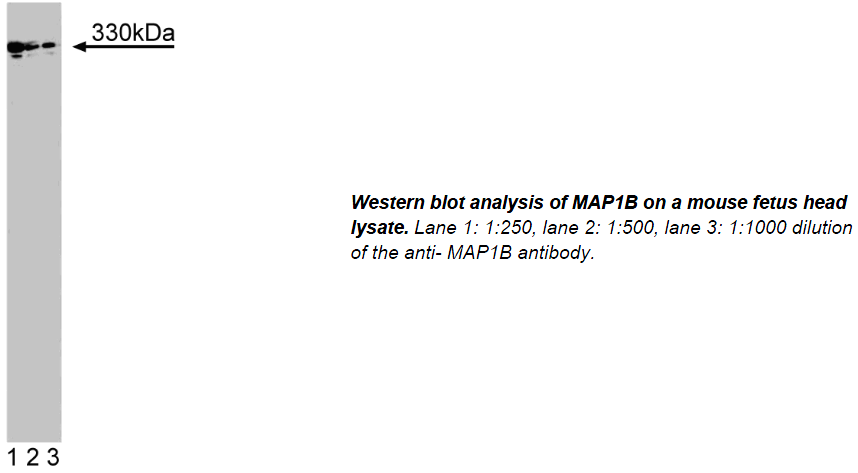
observable to migrate in a range between 320-340 kDa.
原厂资料:
注意事项:
1.Since applications vary, each investigator should titrate the reagent to obtain optimal results.
2.Caution: Sodium azide yields highly toxic hydrazoic acid under acidic conditions. Dilute azide compounds in running water before discarding to avoid accumulation of potentially explosive deposits in plumbing.








 京公网安备11010802025653 版权所有:北京逸优科技有限公司