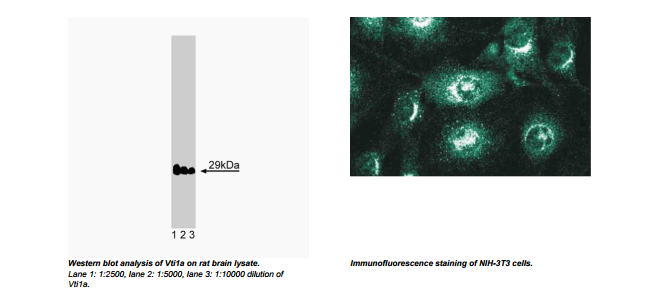
Eukaryotic protein trafficking involves the packaging of molecules into membranous vesicles that bud from a donor compartment, travel to a specific destination, fuse, and release their components into an acceptor compartment. Recognition between vesicle and acceptor membrane is mediated by the pairing of the integral membrane SNARE proteins. The stable interaction between vesicle proteins (v-SNAREs) and target proteins (t-SNAREs) juxtaposes the membranes and results in an activated docked state and/or membrane fusion. VTI1a and VTI1b are putative mammalian SNARE proteins identified by sequence comparison with yeast SNAREs. In line with their involvement in vesicle transport, these molecules are expressed in a wide range of mammalian tissues. Vti1a, a possible t-SNARE, contains a C-terminal hydrophobic domain and several regions that may form coiled-coil structures. It exists in distinct syntaxin 5- and syntaxin 6-containing SNARE complexes within the Golgi apparatus. Inhibition of Vti1a blocks transport of G proteins to the cell surface and results in their accumulation within the Golgi. Thus, Vti1a functions in protein transport within the secretory pathway.
原厂资料:
注意事项:
1.Since applications vary, each investigator should titrate the reagent to obtain optimal results.
2.Caution: Sodium azide yields highly toxic hydrazoic acid under acidic conditions. Dilute azide compounds in running water before discarding to avoid accumulation of potentially explosive deposits in plumbing.








 京公网安备11010802025653 版权所有:北京逸优科技有限公司