The 20S proteasome is the major constituent of the proteasomal complex that mediates degradation events, including the generation of
antigenic peptides that interact with MHC class I. The 20S proteasome is a cylindrical shaped complex composed of four layers of rings, each
with seven subunits. The inner rings contain α-subunits, while the outer rings contain β-catalytic subunits. The constituents of the PA28
activator complex are additional subunits with specialized roles in class I-mediated antigen presentation. PA28 is a ring-shaped structure with
alternating α- and β-subunits. This complex binds the α-rings of 20S and stimulates its activity. Expression of the PA28 α- and β-subunits is
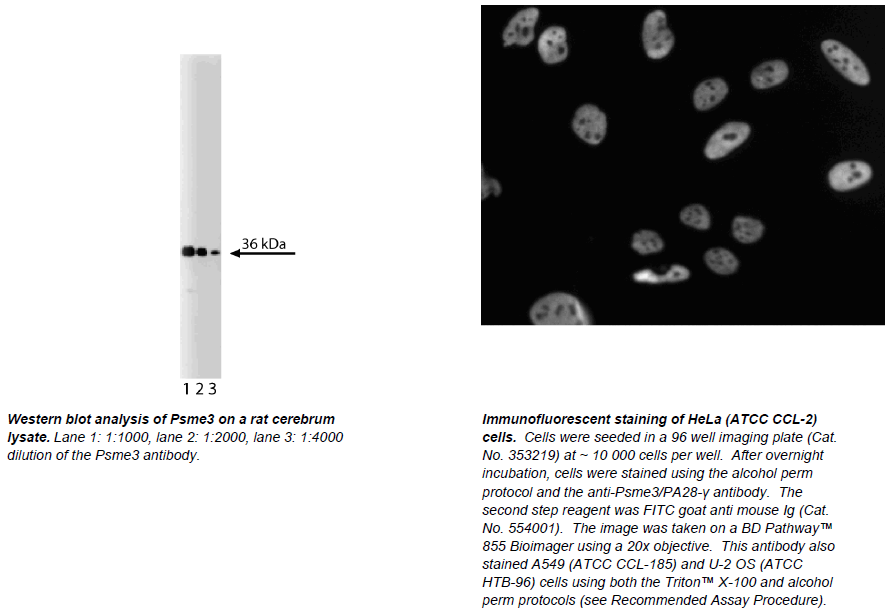
strongly induced by IFN-γ. The protein product of the Psme3 gene, also known as the Ki antigen, is highly homologous to the PA28 α- and
β-subunits and has been designated the PA28 γ-subunit. This protein forms a homohexamer that binds the 20S proteasome and is thought to
modulate proteasome activity. The PA28 α- and β-subunits are located in the cytoplasm and in the nucleus, while the γ-subunit is almost
exclusively nuclear.
原厂资料:
注意事项:
1.Since applications vary, each investigator should titrate the reagent to obtain optimal results.
2.This antibody has been developed and certified for the bioimaging application. However, a routine bioimaging test is not performed on every lot. Researchers are encouraged to titrate the reagent for optimal performance.
3.Caution: Sodium azide yields highly toxic hydrazoic acid under acidic conditions. Dilute azide compounds in running water before discarding to avoid accumulation of potentially explosive deposits in plumbing.








 京公网安备11010802025653 版权所有:北京逸优科技有限公司