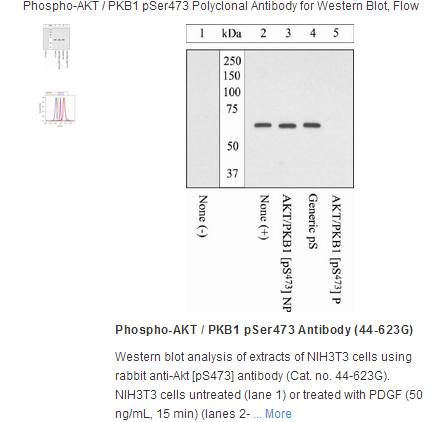
The antiserum was produced against a chemically synthesized phosphopeptide derived from the region of human Akt1 that contains serine 473.
Conjugate
Unconjugated
Form
Liquid
Purification
Antigen affinity chromatography
Storage buffer
Dulbecco's PBS, pH 7.3, with 1mg/ml BSA, 50% glycerol
Contains
0.05% sodium azide
Storage Conditions
-20°C
Tested Applications
Dilution *
Flow Cytometry (Flow)
1:100-1:500
Western Blot (WB)
Assay Dependent
* Suggested working dilutions are given as a guide only. It is recommended that the user titrate the product for use in their own experiment using appropriate negative and positive controls.
AKT1 is one of 3 closely related serine/threonine-protein kinases (AKT1, AKT2 and AKT3) called the AKT kinase, and which regulate many processes including metabolism, proliferation, cell survival, growth and angiogenesis. This is mediated through serine and/or threonine phosphorylation of a range of downstream substrates. Over 100 substrate candidates have been reported so far, but for most of them, no isoform specificity has been reported. AKT is responsible of the regulation of glucose uptake by mediating insulin-induced translocation of the SLC2A4/GLUT4 glucose transporter to the cell surface. Phosphorylation of PTPN1 at 'Ser-50' negatively modulates its phosphatase activity preventing dephosphorylation of the insulin receptor and the attenuation of insulin signaling. Phosphorylation of TBC1D4 triggers the binding of this effector to inhibitory 14-3-3 proteins, which is required for insulin-stimulated glucose transport. AKT regulates also the storage of glucose in the form of glycogen by phosphorylating GSK3A at 'Ser-21' and GSK3B at 'Ser-9', resulting in inhibition of its kinase activity.
原厂资料:
注意事项:
For Research Use Only. Not for use in diagnostic procedures.








 京公网安备11010802025653 版权所有:北京逸优科技有限公司